

What Hypnosis Actually Does to Your Brain (And Why It’s the Most Underrated Shortcut)

Nell Bauduin
juni 20, 2026
8 min read
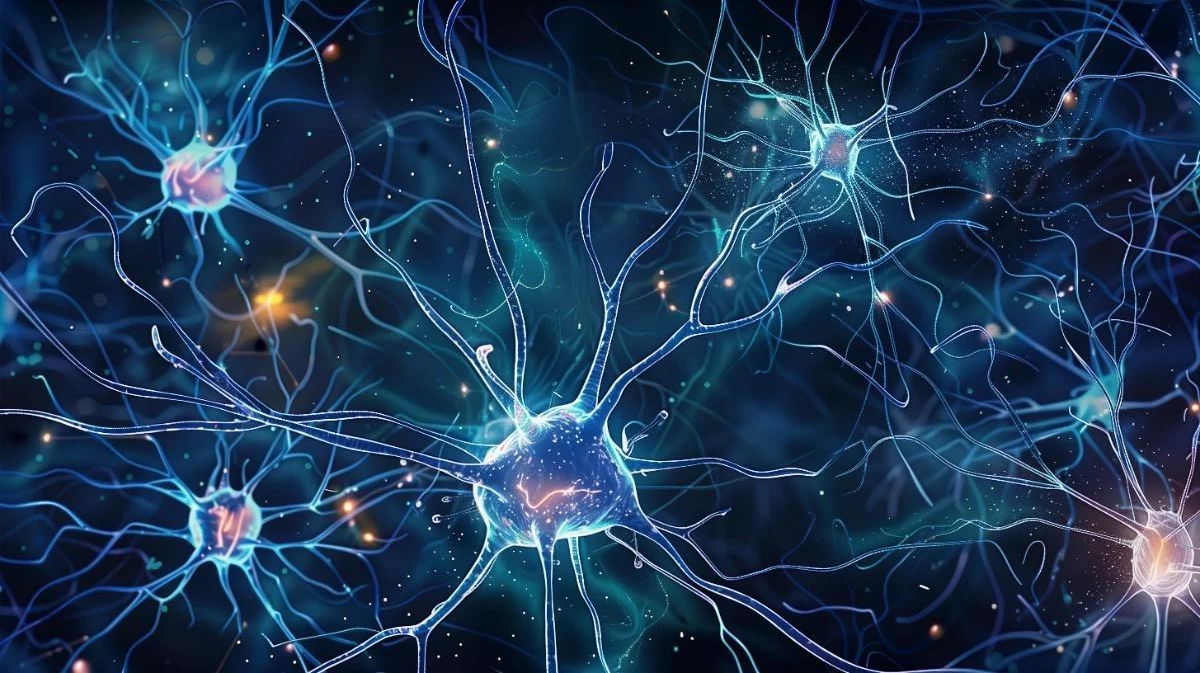
Hypnosis brain science has come a long way from the stage-show stereotype. For decades it was dismissed as a parlour trick or pure compliance. Then neuroimaging caught up — and what fMRI and EEG studies have found over the last two decades is far more interesting than mysticism: hypnosis produces measurable, repeatable changes in brain activity and connectivity. It’s not a metaphor. It’s a distinct neurological state.
If you’ve ever wondered why hypnosis seems to create shifts that years of conscious effort couldn’t, this is why: it works at a level conscious willpower simply cannot reach.
The core insightYour conscious mind processes a tiny fraction of what your brain actually handles. Hypnosis doesn’t fight the other 95% — it speaks to it directly.
What’s Actually Happening in Your Brain During Hypnosis
Three separate studies at the University of Zurich, using fMRI, EEG, and magnetic resonance spectroscopy, found that hypnosis alters activity in the brain’s large-scale functional networks — and changes the neurochemical environment of specific brain regions. This isn’t subjective experience. It’s visible on a scan.
The clearest marker researchers keep finding is a shift toward theta brainwave activity. One 2022 study found theta activity positively associated with hypnotizability and with a measurably decreased response to pain during hypnosis. Theta waves are slower, higher-amplitude oscillations tied to memory storage, emotional processing, and deep attention — which is exactly the kind of access needed to shift a pattern that conscious thinking alone can’t touch.
The 3 Brainwave States You Move Through
A hypnosis session isn’t one static state — your brain moves through a sequence, each with a distinct function.
Waking Alertness
Your normal, analytical waking state. Critical thinking is active. This is where the induction begins.
Relaxed Bridge
Relaxed alertness, similar to daydreaming. The bridge between conscious and subconscious — the doorway opens here.
The Sweet Spot
Deep suggestibility and high neuroplasticity. The state where lasting change is actually installed.
Theta is the same brainwave state active during early childhood — when your core beliefs about safety, money, and identity were first being written. Hypnosis doesn’t bypass your defenses. It simply returns the brain to the state where those defenses were never fully built, making new input possible again.
Why Conscious Effort Can’t Create the Change Hypnosis Can
You can know exactly why you self-sabotage and still do it anyway. That’s not a contradiction — it’s neurology. Conscious willpower operates from the analytical, beta-state mind. The patterns running the show — the automatic reactions, the ceiling, the resistance — live in the subconscious, installed and reinforced long before conscious reasoning could weigh in.
- Bypasses the critical, analytical conscious mind
- Accesses theta state where patterns were installed
- Creates new associations at the subconscious level
- Reduces physiological stress response measurably
- Produces changes visible on fMRI and EEG
- Works only at the conscious, cortical level
- Fights the subconscious instead of accessing it
- Requires constant effort to maintain
- Rarely reaches theta-stored patterns
- Tends to collapse under stress or fatigue
4 Things Hypnosis Actually Does That Willpower Can’t
Bypasses the critical factor
The “critical factor” is the part of your conscious mind that filters and resists new information. Hypnosis temporarily relaxes this filter, allowing direct access to the subconscious without the usual internal debate.
Rewrites subconscious safety associations
Most resistance to growth — financial, visible, relational — is a subconscious safety association, not a conscious belief. In theta state, those associations become available to be updated with new, corrective input.
Measurably lowers the stress response
Research links theta-dominant hypnotic states to decreased pain response and reduced physiological stress markers — the nervous system shifting out of defense mode and into a state where change is biologically possible.
Builds new neural pathways through repetition
A single session creates access. Repetition is what makes the new pattern the brain’s default. This is why consistent practice — not a one-off session — produces lasting identity-level change.
How Hypnosis Actually Works: 3 Steps
Induction — beta to alpha
Through focused relaxation, the brain shifts out of analytical beta activity into alpha — a relaxed, receptive bridge state. This is the doorway opening, not the destination.
Deepening — alpha to theta
Guided deepening moves the brain further, into theta — the high-plasticity state where the critical conscious filter is at its most relaxed and the subconscious is most receptive.
Suggestion and integration
In theta, targeted suggestion installs new associations directly. Integration afterward — through repetition and real-world reinforcement — is what makes the shift permanent rather than temporary.
Install your next-level identity — at the subconscious level.
A group container that uses hypnosis, somatic work and identity-level reprogramming to install the next version of you — permanently.
Somatic work
Identity reprogramming
Group container
€4,000 · Group program · Enrollment opens periodically
What Changes After Consistent Hypnosis Practice
The shift isn’t usually dramatic in the moment — it’s cumulative. What people report after weeks of consistent practice tends to look like this:
- Reactions that used to feel automatic start to feel optional
- Old anxiety triggers lose their intensity without conscious effort
- New behaviors that once required willpower start to feel natural
- Sleep and baseline stress markers often improve alongside the targeted change
- The gap between “knowing” and “doing” starts to close
Frequently Asked Questions